There's a moment that plays out in emergency departments across Kerala every single day.
An ambulance pulls into the bay. The doors open. And only now — with a critical patient on the stretcher — does the ED begin to find out who this person is, what happened to them, and what they need.
A stroke? A cardiac arrest? A road traffic accident with multiple injuries? The team finds out in real time, at the door, while the clock that matters most has already been running for thirty, forty, sixty minutes.
We call this the blind ED problem. And it isn't caused by bad hospitals or careless staff. It's caused by the way emergency information travels today — which is to say, barely at all.
How the information actually moves today
Trace a typical private-sector emergency in Malappuram and you'll see the problem clearly.
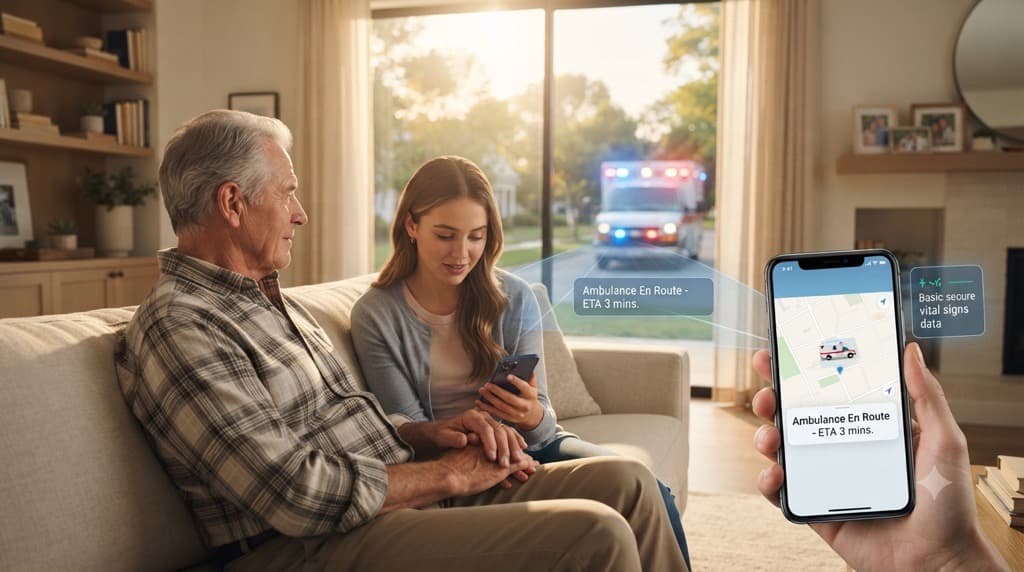
A patient collapses at home. A family member calls an ambulance — often a private operator reached through a phone number saved from a poster or a previous emergency. The driver starts navigating from memory while trying to call ahead to the hospital on his personal phone. If the call connects, it usually reaches a receptionist, who takes a verbal message and passes it along, hopefully to the right person, hopefully accurately.
In practice, the ED gets somewhere between thirty and sixty seconds of usable warning. Sometimes none at all.
That means the right bay isn't staged. The right specialist hasn't been called. Imaging hasn't been ordered. The team starts preparing from zero after the patient has already arrived.
The government's 108 network, for all its scale, has the same structural gap: there is no hospital-facing pre-alert system, no shared case record, no console that tells a receiving ED what's coming. The hospital is blind until the ambulance is at the gate.
Why minutes at the door are the expensive minutes
For time-critical emergencies, the cost of this blindness is measured in outcomes, not inconvenience.
Stroke is the clearest example. Every minute of delay before thrombolysis costs brain tissue. A 2025 study of 456 stroke cases found that structured pre-alerts — where the receiving hospital gets advance, structured notification rather than an ad-hoc phone call — cut average door-to-needle time from roughly 33.7 minutes to 27.2 minutes, and patients showed measurably better functional recovery at 90 days.
Six minutes may not sound dramatic. In stroke care, it is the difference between a patient who walks out of the hospital and one who doesn't walk again.
The same logic applies to STEMI, major trauma, and obstetric emergencies. In every one of these, the receiving team's preparation time is clinical time. When the ED knows what's coming, the bay is staged, the specialist is paged, and treatment starts within seconds of arrival instead of after a scramble.
The fix isn't heroics. It's information flow.
The blind ED problem doesn't need better doctors — Kerala's hospitals have excellent ones. It needs the information about an incoming patient to arrive before the patient does, in a form the ED can act on.
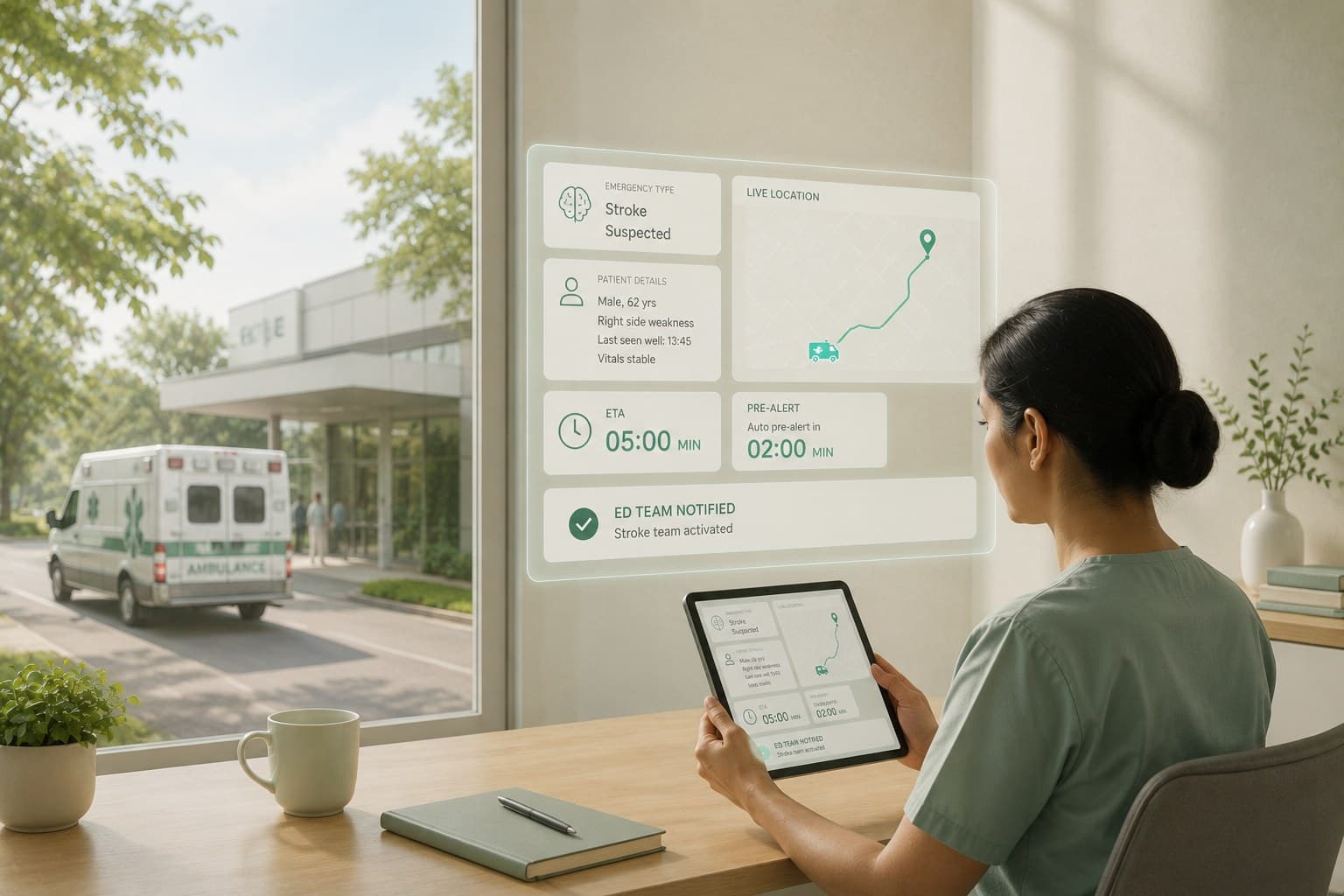
That's what we built into CareFirst. The moment a patient is loaded into a CareFirst-connected ambulance, the receiving hospital's ED display lights up with the case: the emergency type, the patient's details as captured by the dispatch team, the ambulance's live position on a map, and its ETA. An automatic pre-alert fires at five minutes out, and again at two minutes out.
Behind that display sits the rest of the loop: a patient SOS app, a clinically staffed Care & Command Centre where doctors and EMTs triage every case, and a driver app that keeps the ambulance's position and status flowing in real time. Every step — dispatch decision, driver movement, handover — is timestamped on an append-only case timeline, which also happens to be exactly the kind of documentation NABH audits ask for.
To be clear about what this is and isn't: CareFirst doesn't diagnose, and it doesn't replace clinical judgment. Every dispatch and hospital decision is made or confirmed by a trained human dispatcher. What the platform does is make sure that by the time the ambulance doors open, the ED already knows everything the dispatch team knows.
The doors open. The team is ready.
That's the whole idea, and it's deliberately unglamorous. No new machines in the resus bay, no change to clinical protocols. Just the elimination of a blind spot that hospitals have lived with for so long it stopped being noticed.
CareFirst is live today at Almas Hospital, Kottakkal, where the Care & Command Centre coordinates emergencies end to end from the SOS press to the ED handover, on one audited platform. As neighbouring hospitals join the network as receiving partners, every one of them gains the same advantage: patients who arrive pre-announced, pre-routed, and expected.
Because the moment an ambulance arrives should be the moment treatment begins — not the moment your ED starts learning who's on the stretcher.
CuraNova Global Med LLP builds emergency coordination infrastructure for hospitals. CareFirst AI and the Care & Command Centre are live at Almas Hospital, Kottakkal. To learn about joining the receiving-hospital network, contact us.
Found this article useful?
Share it with your network to spread awareness about emergency response innovation.
Ready to close the gap?
See how CareFirst AI can transform emergency coordination at your hospital. Schedule a demo with our team.